Showing posts with label slasher. Show all posts

Tuesday, March 11, 2014

SXSW World Premiere: Among The Living (Aux Yeux Des Vivants)

Last night, I had the pleasure of attending the world premiere of Alexandre Bustillo and Julien Maury's latest film, Among The Living (Aux Yeux Des Vivants), at the SXSW Film Midnighters series. Maury himself was on hand at Austin's Stateside Theatre to answer audience questions after the screening, and gave some great insight into this third film from the directorial duo. Maury stated that he and Bustillo do, in fact, consider their three films to date (2007's Inside [Á L'interieur] and the 2011 Livid [Livide] together with Among The Living) to make up a trilogy of sorts, though the plots and settings of the three differ greatly. Viewers of all three will find some definite thematic similarities, starting with the fact that all of the films deal with family and parenthood through a warped lens. According to Maury, Inside was their love letter to the slasher genre, while Livid owed more to the Gothic atmospheric horror of the mid-20th century. Among The Living, however, pays clear homage to American horror films of the 1980s, with obvious nods to films like The Hills Have Eyes and The Texas Chain Saw Massacre. 


Among The Living gives viewers the opposite of what they expect from the very first scene, setting an uneasy tone that lasts the full 90 minutes of the film. We follow a group of early trick-or-treaters up the steps of a run-down home in a rural town, and meet a husband and wife whose unhappiness is palpable. The wife, evidently about nine months pregnant, waits on her husband hand and foot while he watches a news program about known birth defects in the children of soldiers subjected to a particular form of chemical warfare. In a subtle bit of exposition, his dog tags glint at his chest and a vein throbs at his temple, and he is struck by a bizarre attack that involves strange and disturbing images flashing behind his eyes one by one. The audience is forced to join him for this, and when we return to reality, we've almost completely forgotten his hapless wife, who appears suddenly behind him with a bat and cracks him several times on the head.


 Leaving her husband for dead, she trades the bat for a rather large kitchen knife, and ascends the stairs to the bedroom of another child the audience has hitherto been unaware of. We watch through the child's eyes as his mother advances toward him, slashing wildly with the knife. Somehow, his father makes it upstairs just in time and puts a stop to the attack, but his wife, in her desparation, turns the knife on the unborn child in her belly. Father comforts young Klarence, and the two make plans to disappear and start a new family, among the living. True to their roots in extreme gore, the directors make sure that we stop to take in the wound where the woman's fetus has been removed and taken away.


Exposition behind us, we now move into the true first act of the film, and meet our protagonists, three junior high school-aged boys whose classroom antics earn them detention on the last day of the school year. But instead of serving their sentence, the three decide to ditch campus and smoke cigarettes in a picturesque field abutting the barn of a cranky old man. When a misguided attempt at arson goes awry, the three flee to a far more interesting place to hide out and avoid the consequences: the nearby Blackwood Studios, an abandoned lot of film sets that have been left to vandals for many years. It is here that the boys encounter a hulking figure in a clown mask who has a woman bound and gagged in the trunk of a car. When they bring the police back later to check it out, their story is written off as some sort of boy-who-cried-wolf scenario, and they return to their homes for varying degrees of punishment. 


But Klarence and his father have been found. Their hideout and bizarre rituals at Blackwood Studios are threatened, and so Klarence must pay each of the boys a visit, in turn, to ensure that they never bring any more police to investigate. The remainder of the film unfolds as one of the most unique home invasion horror thrillers you'll ever see, with a monster that will haunt you long after the film concludes. The actors playing the three boys are quite good, and their on-screen chemistry with the other characters in their lives makes it hard to watch as the body count rises. However, the directors have found a rare balance in evincing sympathy for the attacked as well as the attacker, and Klarence comes with his fair share of pathos. But don't think for a moment that this film does not bring to the table some very creative and shocking violence. Bustillo and Maury show a great understanding of body horror in some key climactic scenes, with excruciating pacing that had the premiere audience squirming in their seats.


One of the things I found to be most unsettling about Among The Living was the film's insistence that our protagonists were not safe even in the daylight. So many films allow viewers to feel secure in the fact that the daytime is safe, but as soon as the sun goes down, to expect things that go bump in the night. In this film, several of the tensest sequences take place in broad daylight, which means that the audience never gets a chance to relax back into their seats. Composer Raphael Gesqua's score is equally relentless, and so original as to remain stuck in your head for hours after you leave the theatre. The first two acts of the film feature whimsical, almost carnival-like melodies, tainted with slight hints of discord that portend bad things ahead. The climactic scenes, on the other hand, are swept along with a brisk and almost lilting score that is both classic and fresh, and wouldn't be out of place in one of James Whale's original Frankenstein films.

As of now, this film has a release date of April 10th in Belgium, where much of the shooting took place. There doesn't appear to be a US release planned just yet, but if you're in Austin for SXSW, you'll have two more chances to catch this one screening at the Alamo Ritz, tonight at midnight, and again Friday at midnight. Keep an eye on Metaluna Productions who may have further information about a much-needed international release for this striking film.

Wednesday, August 21, 2013

You're Next Is One Twisted Laugh Riot

Last night I was fortunate enough to snag a pair of last-minute passes to an advance screening of You're Next, the latest effort from Adam Wingard and Simon Barrett. I have to say, I went in with the expectation of watching The Purge again, but with less sociopolitical commentary and more gore. I was pleasantly surprised to find myself watching a deliciously tongue-in-cheek, fucked up black comedy that went far beyond any plot twist hinted at by the trailers. Having premiered at the 2011 Toronto International Film Festival, this little gem is finally seeing a well-deserved wide theatrical release on Friday.


You're Next sets a pretty dark tone from the get-go, with the opening sequence showing the graphic deaths of two neighbors, a middle-aged rich guy and his young trophy wife. Soon after, the Davisons pull up to the door of their country home, next door to the two corpses, and begin preparations for what will naturally be a very tense reunion of their four children and their partners. As the family members arrive one by one, their every move is watched by anonymous villains hiding in the trees. But the Davisons, squabbling over trivial things and rehashing old family arguments, remain oblivious to the eyes on them. Only the sister's boyfriend, independent filmmaker Tariq (played by Ti West in an amusing cameo), notices the movement in the woods outside, and when he approaches the window to get a better look, he gets an arrow to the head.


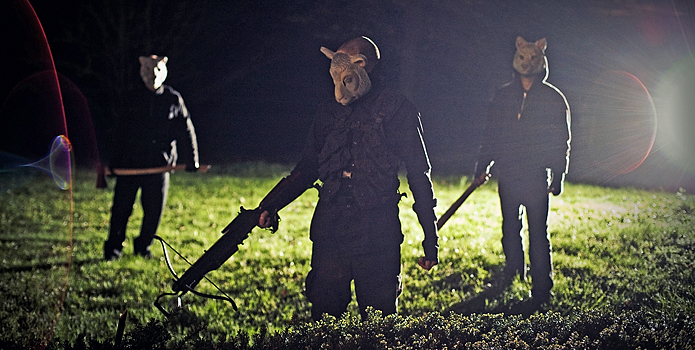
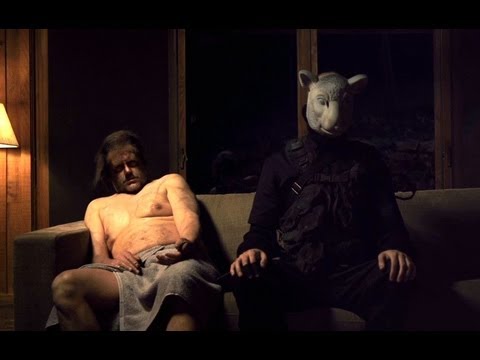
The next twenty minutes of the film play out much like a standard home invasion thriller, with the family hysterical and running around in circles, making the worst possible decisions about their own survival. After a couple more deaths, we meet the Davisons' anonymous assailants - the men in animal masks so prominent in the film's marketing campaign. The violence escalates gradually, as the Animals come after them with crossbows, machetes, razor wire, and more. But what The Animals didn't bargain for is Aussie hottie Erin (Sharni Vinson), girlfriend of brother Crispian Davison, whose survivalist upbringing make her the perfect final girl for this unconventional slasher tale. Erin is the voice of reason, keeping the family members away from windows, contacting the police right away, and setting gruesome traps for the Animals. The second half of the film consists largely of Erin kicking ass and owning the Animals in a hilarious gorefest. That, and, of course, the answer to the film's big question: who are the Animals, and why are they doing this to the seemingly innocent Davisons? You'll have to buy a ticket and go check out the film for that one.


This is a film with a huge amount of atmosphere, having been shot entirely on the premises of one large, remote old house. From the Davisons' perspective, we see out the house's many windows into the dark of night in a heavily wooded area, where anything could easily hide. Every so often, the camera changes hands, and we see into the house as the Animals, tracking the Davisons from room to room as they move in the lighted windows. The film makes great use of some slasher film tropes and traditional jump scares, because as much as the avid horror fan may seem them coming, it just wouldn't be as fun without the face under the bed, or hiding behind that open door.


I found one scene in particular to be especially gorgeous and well-executed. Erin, hiding in the basement and unsure of who might be left alive upstairs, springs a trap for one of the animals who has pursued her downstairs. She sets up a camera to illuminate her assailant, shocking him into blindness as he crosses the room. The camera flash repeats at intervals, breaking the darkness into quick shots of light. Not only was it a clever device for our crafty heroine to utilize, but the visual effect was unique and stunning.


The entire cast gives great performances as a family with a lot of skeletons in their closet. There is a genuine quality to the familial interactions - the competitive siblings, doting parents, and nervous significant others come across perfectly. Joe Swanberg shines as the most irritating and condescending of the brothers, and he is gifted with some of the film's most hilarious lines of dialogue. A.J. Bowen, on the other hand, gives an endearing performance as the academic black sheep of the family, whose professional failures are irresistible to his brothers and father. Barbara Crampton plays the drug-addled and somewhat tragic matriarch in a very classic style.


You're Next really does have something for every horror fan. Lovers of everything from The Purge back to John Carpenter's Halloween will find something to enjoy, as will fans of the Evil Dead films and Robert Rodriguez's Planet Terror. Without revealing too much and spoiling the juicy twists and turns of a really solid film, I absolutely urge you to check this out when it opens Friday. Support horror releases from major studios like Lionsgate, and we'll continue to see quality work like this make it to the big screen.

On a side note, the final installment of Edgar Wright's Blood and Ice Cream trilogy, The World's End, also opens this weekend. Check out my review here.

Tuesday, July 30, 2013

The Child's Play Saga: What Can We Expect from Curse of Chucky?

By now, we've all seen the trailer for Don Mancini's upcoming sixth installment of the Child's Play franchise, Curse of Chucky. Out October 23rd on DVD and VOD, Curse of Chucky is being promoted as a return to the straight-up horror style of Child's Play 1-3, and a departure from the satirical, meta-horror approach taken by Bride of Chucky and Seed of Chucky. To stave off my own impatience for the new film's release, I decided to sit down and re-watch all five existing films in succession, and share some of my thoughts about the progression the franchise has taken thus far, and where it sounds like it's going.


Mancini has said that his initial idea for Child's Play was to comment on the influence that advertising has on children. In the first film, our young hero Andy begs and begs his hard-working single mother to get him a Good Guy doll just like the ones on TV, but the two get more than they bargained for when Andy's mother brings home the very doll that plays host to the soul of serial killer Charles Lee Ray, voiced by Brad Dourif. Despite a somewhat silly premise (Ray uses a voodoo incantation to move his soul into the doll when he is mortally wounded in a police firefight), this first film spawned a genuinely frightening and enduring villain, and what was originally intended as a stand-alone film grew into a blockbuster franchise. What makes Chucky the killer Good Guy doll such a spectacular horror antagonist? The first film achieves great effect by placing an innocent child in harm's way, a device used so well in classics like The Exorcist and The Shining. The viewer's care for the welfare of the character in danger leads to a deep emotional connection for viewers. The adults in the child's life write off the horrors he is experiencing as products of an active imagination, which is frustrating and upsetting to watch as the film goes on. This level of attachment to the character of Andy continues as the doll follows him to a foster home in Child's Play 2, and to military school in Child's Play 3. 


In bringing the character of Chucky to life, Mancini also had great success playing on the fan following of A Nightmare on Elm Street villain Freddy Krueger. Krueger's smart-assed one-liners and snide attitude toward his victims made him completely unique to the slasher genre, and coming just a few years on the heels of Elm Street's inception, Child's Play created a similar comedic killer. Brad Dourif delivers Chucky's lines with a trademark gravelly tenor, and his characteristic laughter as he commits horrific murders brings glee to his legions of morbid fans. Effects designers did a brilliant job of underscoring the change that Chucky undergoes when he switches from his Good Guy doll appearance into full Charles Lee Ray. His smiling doll features twist into a grotesque grin, and his voice drops from a sweet, high-pitched boy's to a deeper and much more sinister man's. The juxtaposition of a lovable child's toy with the personality of a ruthless serial killer converges into one of horror's most iconic slashers.


With 1998's Bride of Chucky, the franchise took a turn toward the ironic meta-horror style popularized by the Scream films, and followed up on its success with the 2004 Seed of Chucky. Both films gained another great comedic role with the addition of Jennifer Tilly as Chucky's bride, Tiffany, and then as herself, playing the role of Tiffany in a film-within-the-film. The classic slasher film elements of the first three films gave way to slapstick comedy, plenty of adult humor surrounding Tiffany and Chucky's relationship, and a self-referential tone designed to appeal specifically to die-hard horror fans who had already seen it all.


Watching the five Child's Play films again, I was struck by the consistency of the character of Chucky, and I think that Brad Dourif's continued involvement in the franchise is the glue holding it together. Despite changing directors for each successive film, the most memorable character has remained just as well-written and portrayed, and that makes for an enduring franchise. So what does Mancini have in store for Curse of Chucky? We can certainly expect darker plot elements, as the official synopsis includes the detail that the protagonist will be dealing with the recent suicide of her mother. While the link between the first Child's Play film and this one remains ambiguous, we've been told that Chucky intends to settle a score from more than 20 years ago, which suggests a full-circle reckoning to the original backstory of Charles Lee Ray. And as far as character design goes, the Chucky depicted in the official trailer has been returned to his original, brand-new Good Guy look, the stitches and scars of the last two films having been removed.

Don't let the straight-to-DVD release of this film turn you off from giving it a watch. For fans of the original Child's Play film, Curse of Chucky should prove to be a well-executed return to form, and bring Chucky back to life in a more terrifying form than ever before.

Monday, July 29, 2013

BANNED in New Zealand: What Makes Franck Khalfoun's Maniac So Twisted?

While I may be a little late to the party on this one, I finally got around to watching Franck Khalfoun and Alexandre Aja's remake of the 1980 slasher film Maniac, starring Elijah Wood, which made the festival circuit last year and saw a limited theatrical release earlier this month. I was finally spurred to check this one of the long, long list of films I've been meaning to see by the news circulating this week that New Zealand's Office of Film and Literature Classification had banned the film from being screened outside of film festivals or academic study. And while I do not in any way whatsoever condone the banning of films or other artistic materials, I wanted to take a minute to examine some of the things that set Maniac apart from other violent and disturbing horror films, and look for some insight into why the OFLC chose to keep this film from the eyes of New Zealand's viewing public.


The shooting style of this film makes it unlike any other in that nearly the entire film is shot in first-person perspective through serial killer Frank Zito's eyes. This is of course a very literal interpretation of an effect that many directors try to achieve through storytelling, and it takes some getting used to in the beginning of the film. However, the murders and violent mutilations that Frank performs on his victims become that much more disturbing up close from his perspective, and the effect achieved as the women look into the camera with pleading eyes, attempting to fend off attacks coming from the viewer's perspective, is genuinely disturbing. Being quite literally inside of the killer's head also helps lend a sympathetic bent to his character, as we see through his own eyes flashbacks to his childhood, and watch his mother bring strange men into their home and her bed.


And the particulars of the violent murders depicted in Maniac are definitely outside the parameters of what the modern horror fan has seen a hundred times. As in William Lustig's original, Frank's signature when killing is to remove the women's scalps, which he then affixes to his collection of mannequins to create lifelike companions. Outside of the 1980 Maniac, the only other film with a scalping scene that immediately comes to mind for me is Rob Zombie's House of 1000 Corpses. The idea is certainly not done-to-death, but what really made these scenes difficult for me to watch was the speed at which the act was shown. Modern horror leans a lot on quick slicings and dicings with giant arcs of blood spraying all over. However, Frank performs his scalpings slowly and with great care, in order to keep his trophies intact. Thick, dark blood pools slowly around the skull as he delicately peels the scalp away, and the viewer is forced to watch the surgery right up close until he is squirming in his seat or averts his eyes.


There is absolutely no Hollywood style or flash to this film, other than perhaps the beautiful minimalist soundtrack. There is a poignant sadness to Frank Zito's insanity and the manner in which he kills that feels so much more real than the gleeful axe-wielding psychopaths we horror fans are accustomed to seeing, and it stayed with me much longer than usual. Watching this film made me feel intensely connected to its main character, and really left me feeling unclean afterward. Bearing that in mind, the New Zealand OFLC's ban comes as no surprise from a country known for censoring both games and films, the most recent of which being the 2006 documentary The Bridge, which dealt with suicides at the Golden Gate Bridge.

All that being said, I would encourage readers from countries in which the film remains widely available to give this one a watch. Khalfoun has achieved a level of emotional depth seldom found in a slasher film, and Elijah Wood gives a deeply troubling performance in a role that is sure to land him plenty of future roles in genre films.